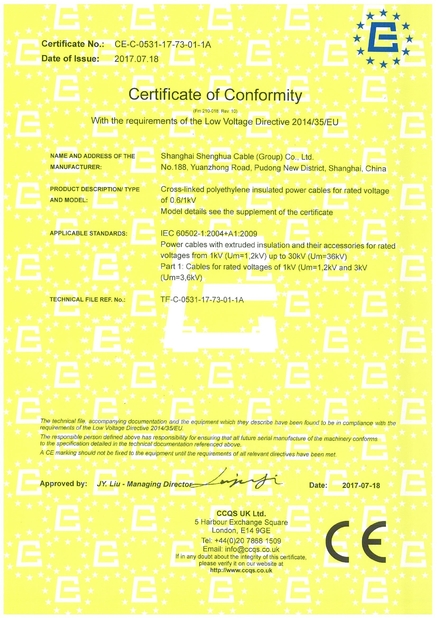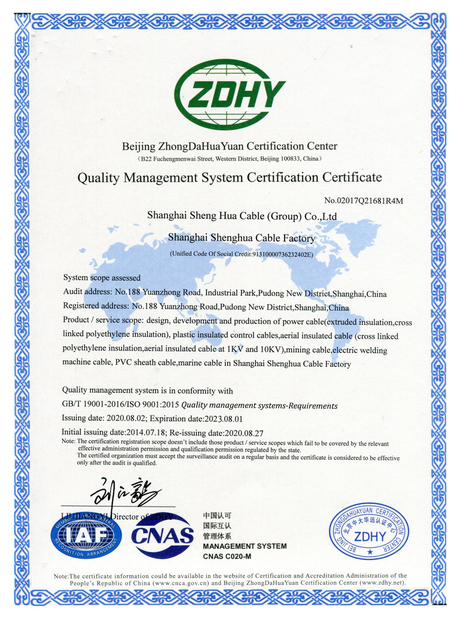
Cavo di Shanghai Shenghua (gruppo) Co., srl.
ABC aerial bundled cable is the fastest route to a reliable low-voltage overhead network, and Shanghai Shenghua Cable Group has manufactured it since 1997 for utilities, EPC contractors and rural electrification programmes. This guide explains how triplex and quadruplex ABC aerial bundled cable is constructed, why utilities replace bare open wire with bundled XLPE or PVC insulated conductors, and how to specify messenger size, conductor cross section, span and UV performance for tropical, coastal and desert climates. You will also find a practical selection table, installation rules and six practical technical answers that buyers ask most often, all based on IEC 60502-1 and NFC 33-209 practice.

ABC aerial bundled cable (also written aerial bundled conductor, ABC cable or aerial bunch cable) is a low-voltage overhead distribution cable in which two, three or four individually insulated phase conductors are twisted around a bare or insulated neutral/messenger conductor to form one compact assembly. The rated voltage is normally 0.6/1 kV, and the construction follows either the European tradition of NFC 33-209 or the general requirements of IEC 60502-1. Conductors are class 1 or class 2 aluminium, aluminium alloy (AAAC) or copper, with XLPE, PE or PVC insulation extruded to a defined thickness so that the phase cores remain electrically independent along the whole span.
The three common configurations are:
Mechanically, the messenger carries the whole tensile load, so its cross section is chosen from span length, wind and ice loading and permitted sag rather than from current alone. Thermally, each insulated phase core carries current, and its XLPE insulation is rated for a continuous conductor temperature of 90 degrees Celsius, while PVC insulated ABC variants are typically rated 70 degrees Celsius. The insulation is compounded with carbon black or dedicated UV stabilisers because the assembly is permanently exposed to sunlight, ozone and pollution.
| Parameter | Typical ABC range |
|---|---|
| Rated voltage | 0.6/1 kV (600/1000 V) |
| Phase conductor | AAC, AAAC or copper, 16-150 mm2 |
| Messenger | AAAC or galvanised steel, 25-70 mm2 |
| Insulation | XLPE, PE or PVC, UV stabilised |
| Conductor temperature | 90 C (XLPE), 70 C (PVC) |
| Reference standards | IEC 60502-1, NFC 33-209, IEC 60228 |
Bare overhead lines work, but they fail in predictable ways: conductor contact with trees, accidental touching during storms, illegal tapping, and phase-to-phase short circuits when wind swings conductors together. ABC aerial bundled cable removes most of these failure modes because the insulation is factory applied and the cores are twisted into a fixed geometry that cannot clash. For a distribution utility the consequences are measurable in SAIDI and SAIFI figures, and for a contractor they show up as fewer call-backs in the warranty period.
1. Reduced fault rate and fewer outages. Because the phase cores are insulated, tree contact and bird contact no longer create earth faults. Utilities in Latin America, Africa and South Asia that converted bare open wire to ABC typically report a step change in the number of transient faults on rural feeders. The bundled geometry also prevents phase-to-phase contact under wind-induced oscillation, which is a common cause of nuisance tripping on long spans with wide conductor spacing.
2. Theft and illegal connection resistance. A bundled assembly is harder to tap than an exposed bare conductor. Combined with insulated service cables and sealed connectors, ABC aerial bundled cable materially reduces non-technical losses in areas where direct hooking is common. Many utility specifications now mandate ABC for exactly this reason, and the incremental cable cost is recovered through reduced loss levels within a few years.
3. Lower installation cost and faster stringing. One assembly replaces three or four separate conductors, three or four sets of insulators, and the associated crossarms. Stringing, tensioning and sagging are performed once. On rural electrification projects where labour and crane time dominate the budget, ABC typically reduces installed cost per kilometre even when the cable price per metre is higher than bare wire.
4. Narrow corridors and urban aesthetics. Because phase spacing is fixed and small, ABC requires a much narrower right of way. It can be strung on building facades, along narrow streets and through vegetation that would otherwise need heavy trimming. The compact silhouette also satisfies municipal visual requirements in tourist and residential areas.
5. Corrosion and environmental performance. Modern ABC insulation compounds are formulated for UV exposure, and the AAAC messenger resists the galvanic problems of bare copper-to-steel contact. In coastal and industrial atmospheres the sealed construction keeps moisture away from the conductor, so the service life of an ABC aerial bundled cable span is generally longer than that of an equivalent bare line with clamped connections.
Specification starts with the electrical duty and ends with the mechanical duty. First calculate the design current for the feeder or service, apply the correction factors for ambient temperature and solar gain, and select the phase conductor from the current-carrying table of IEC 60502-1. For a 0.6/1 kV three-phase four-wire rural feeder with a 200 A design current, a 70 mm2 AAAC phase conductor is a typical starting point, but the final choice must respect the permitted voltage drop, usually limited to 5-6 percent at the remote end of the line.
Second, size the messenger. The messenger must carry the weight of all cores plus wind load and, where applicable, ice load, at the specified maximum span without exceeding the permitted sag. As a practical rule, spans up to 40 m are common in urban service connections and spans up to 60-80 m appear in rural distribution; beyond that the messenger cross section and the pole class must be recalculated. Tension stringing should use a dynamometer and a sag template, and the cable must be pulled from a free-running drum with a swivel so that the twist lay is not disturbed.
Third, protect the insulation during installation. Sheaves must be smooth and large enough to keep the bending radius above the manufacturer value, typically 12-15 times the overall diameter for a bundled assembly. Cores must never be dragged over rough ground, and the end seals must stay in place until termination, otherwise moisture migrates along the stranded conductor. For coastal and industrial sites, apply a sealing compound or a heat-shrink end cap on every cut end before the drum leaves the store.
Fourth, terminate and earth properly. Insulation piercing connectors are the standard accessory for ABC because they avoid stripping the insulation in the field, which is where most water ingress starts. The neutral or messenger is earthed at every transformer pole and at defined intervals, and the earthing resistance must be measured and recorded. Where the ABC feeds a building, an insulated service cable with a sealed entry gland completes the transition from overhead to indoor wiring.
Fifth, verify before energising. Insulation resistance tests between phases and between phase and messenger, continuity of the messenger, and a visual check of sag and clearances should all be documented. A sample of the delivered drum should be checked for insulation thickness, conductor diameter and twist lay against the test certificate, especially when the cable is sourced across markets.
A worked voltage drop check keeps the design honest. For a 400 V three-phase feeder carrying 150 A over 800 m with a 70 mm2 AAAC phase conductor, the resistance at 90 degrees Celsius is roughly 0.00043 ohm per metre, so the line drop is approximately 3.09 x 150 x 0.00043 x 800 divided by 1000, close to 16 V per phase, or about 4 percent of phase voltage. Because the neutral and messenger add a small additional drop, the design still sits inside the usual 5 percent limit, but a 50 mm2 conductor would push the figure beyond it. This is why ABC sizing must be done on voltage drop as well as on thermal current, especially on long rural feeders where the load centre is far from the transformer.
Accessories deserve the same discipline as the cable. Insulation piercing connectors should match the conductor range and be torqued with a calibrated tool, because an under-torqued contact becomes a hot spot and an over-torqued one crushes the aluminium strands. Suspension clamps must have elastomer inserts to avoid abrading the insulation at the point of support, and dead-end clamps must be sized to the messenger rather than to the overall bundle diameter. Spiral or preformed ties are preferred over hand-tied wire because they distribute the mechanical load along the insulation instead of concentrating it at one point. On long runs it is worth specifying a small spare length at each pole so that future re-sagging or re-routing does not require a joint.
Acceptance testing closes the loop. Insulation resistance measured with a 1000 V tester after 60 seconds should be recorded for each core against the messenger and against the other cores; values in the hundreds of megohms indicate a sound dry insulation. Continuity and resistance of the messenger confirm that the mechanical path is also the earthing path. Where an ABC feeder is delivered in drums of 500 m or 1000 m, the drum length should be verified against the delivery note, and the remaining length recorded so that the next span is planned without a mid-span joint.
| Installation step | Key control point |
|---|---|
| Route survey | Span length, clearance, tree growth, pole class |
| Drum handling | Free-running drum, no twist disturbance |
| Stringing | Dynamometer tension, sag template |
| Termination | Insulation piercing connectors, sealed ends |
| Earthing | Messenger earthed at transformer poles |
| Commissioning | Insulation resistance and continuity records |
Product examples from current production illustrate the range. The 0.6/1 kV triplex and quadruplex service ABC flame retardant cable to IEC 60332-1 covers service drop work where flame propagation must be limited. The aerial bundled XLPE insulated cable with one messenger conductor is the standard self-supporting solution for rural feeders. For light-duty service connections the 600 V two-core aerial bundled cable offers a compact 2.5-70 mm range, while the three-core triplex service drop cable is used for overhead transmission lines into buildings. Projects that must resist intense solar exposure should look at the ABC 4x35mm2 UV stabilised PVC insulated aerial bundled cable, and where the design calls for a three-phase four-wire layout the 0.6/1 kV triplex and quadruplex ABC for reliable power distribution is the usual choice. Buyers who compare bundled and conventional solutions often cross-check with UV resistant PVC insulated power cable for aerial overhead use.
ABC stands for aerial bundled cable or aerial bundled conductor. It describes a low-voltage overhead assembly in which insulated phase cores are twisted around a messenger, replacing separate bare conductors on insulators.
Triplex ABC has two insulated phase cores and one neutral or messenger core, giving a single-phase three-wire service. Quadruplex ABC has three insulated phase cores plus a messenger and serves three-phase four-wire loads.
ABC is designed for overhead use. Its insulation and messenger geometry are optimised for tension stringing and UV exposure, not for soil pressure, so direct burial should use armoured or sheathed underground cable instead.
XLPE allows a 90 degrees Celsius conductor temperature and higher current for the same cross section, while PVC is limited to about 70 degrees Celsius but costs less. For long feeders with high load, XLPE usually wins on total cost.
Span length depends on messenger size, wind and ice load and permitted sag. Urban service spans are often 20-40 m; rural distribution spans of 60-80 m are common, but the messenger must be recalculated for each case.
No. The messenger or neutral is earthed at transformer poles and at defined intervals along the route, following the local utility earthing standard, with resistance measured and recorded at each point.
ABC aerial bundled cable is not simply a cheaper bare line; it is a different reliability model. Insulated cores cut fault rates, the bundled geometry ends phase clashing, and the fixed messenger simplifies stringing across narrow corridors. Specify the phase conductor from IEC 60502-1 current tables, size the messenger from span and wind load, keep the twist lay intact during installation, and seal every cut end. Shanghai Shenghua Cable Group manufactures 0.6/1 kV ABC in triplex, quadruplex and self-supporting configurations with AAC, AAAC or copper conductors and UV stabilised XLPE or PVC insulation, tested to IEC 60502-1 and NFC 33-209. Send your span, load and climate data through our contact page and our engineers will return a sized quotation, a drum schedule and a test plan for your project.