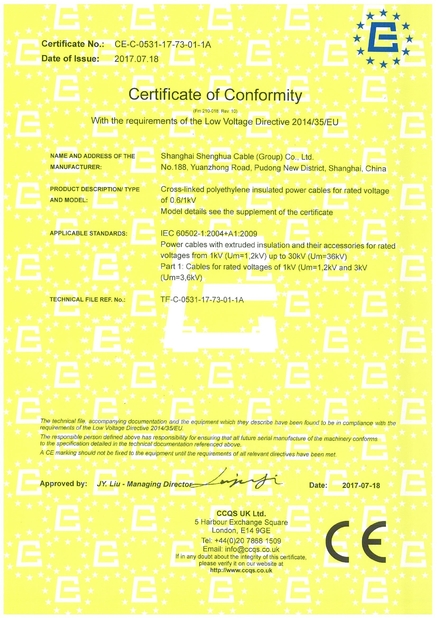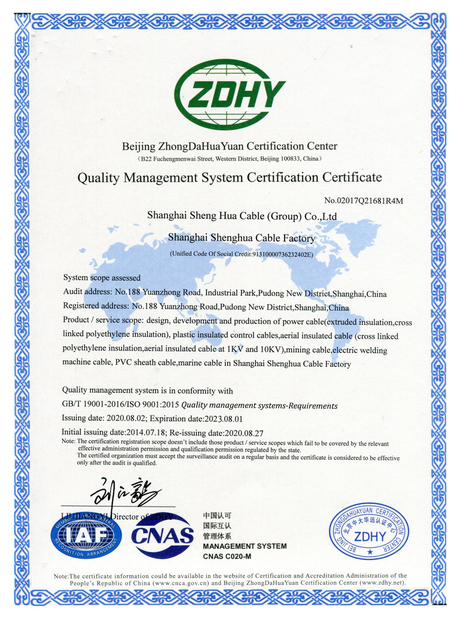
Cavo di Shanghai Shenghua (gruppo) Co., srl.
An enquiry that reads 4/0 AWG cannot be answered with a 95 mm2 quotation, and an enquiry that reads 3x25 mm2 cannot be answered in kcmil, yet buyers and suppliers exchange these units every day and misunderstand each other. AWG and kcmil are North American size designations based on conductor diameter and area in circular mils, while the metric world sizes cables by cross sectional area in square millimetres. They do not convert exactly, because the two systems round differently and because AWG steps are not linear. This guide explains how the systems work, provides the conversion values that matter in cable procurement, and shows how to state a size so that both sides of an order agree. Six answers follow on conversion, ampacity, tolerance and mixed specifications.

AWG numbering runs in the opposite direction to intuition: a smaller number is a larger conductor. The system is defined so that size 36 is a fixed small diameter and size 0000, written 4/0, is a fixed large diameter, with 39 steps between them in a geometric progression. That is why 12 AWG is thinner than 10 AWG, and why 4/0 is far larger than 4 AWG.
Above 4/0 the North American system changes to thousands of circular mils, written kcmil or historically MCM. A circular mil is the area of a circle one thousandth of an inch in diameter, which makes kcmil a direct area measure. A 250 kcmil conductor has an area of 250,000 circular mils.
The metric system is simpler to reason about: the size is the nominal cross sectional area of the conductor in square millimetres, so 25 mm2 means twenty five square millimetres of copper. Standard sizes step through a preferred series, and the resistance per kilometre is defined by the standard for a given class, with a maximum permitted value that allows for stranding.
Conversion is therefore a matter of area. One square millimetre equals approximately 1973 circular mils, so a conductor of area A mm2 corresponds to about A times 1973 circular mils. Working in the other direction, a 250 kcmil conductor is approximately 127 mm2, and a 4/0 conductor approximately 107 mm2, which is why 4/0 is normally quoted against 95 or 120 mm2 depending on the source and the rounding convention used.
| AWG / kcmil | Approximate mm2 | Common use |
|---|---|---|
| 14 AWG | 2.1 | Control and lighting |
| 12 AWG | 3.3 | General purpose circuits |
| 10 AWG | 5.3 | Small power |
| 8 AWG | 8.4 | Sub-circuits |
| 6 AWG | 13.3 | Distribution |
| 2 AWG | 33.6 | Feeders |
| 1/0 AWG | 53.5 | Service entrance |
| 4/0 AWG | 107 | Main feeders |
| 250 kcmil | 127 | Large feeders |
| 500 kcmil | 253 | Heavy industrial |
The first trap is that the two systems do not round to the same value. If a project specifies 4/0 AWG and the factory supplies 95 mm2, the conductor is about eleven percent smaller in area, which reduces ampacity and increases voltage drop. If the factory supplies 120 mm2, the conductor is larger, which is safe electrically but may not fit the lug or the duct. Neither substitution is automatically acceptable.
The second trap is ampacity. Ampacity depends on insulation temperature rating, installation method, ambient temperature and bundling, so the same conductor size has different ratings in North American and IEC tables. A 4/0 THHN in free air carries a different current from a 4/0 XLPE cable in a duct, and neither number can be transplanted into the other system's table without recalculation.
The third trap is conductor stranding and class. AWG conductors are described by strand count and class in North American practice, and metric conductors by class 1, 2, 5 or 6. A 250 kcmil class B conductor and a 127 mm2 class 2 conductor are similar but not identical in strand pattern, which affects flexibility and termination.
The fourth trap is voltage designation. A North American 600 V cable and a European 0.6/1 kV cable are not the same product even though the numbers look related, because the insulation thickness and test regime differ. Mixing the two in one specification produces a cable that satisfies neither standard.
The fifth trap is documentation. A quotation that states only the converted size, without the original designation, cannot be checked. Both designations should appear together, with the resistance value, so that the buyer can verify equivalence rather than trusting the arithmetic.
Quote the original designation and the metric equivalent in the same line, and add the area so there is no doubt: 4/0 AWG, approximately 107 mm2, copper class B stranded, 0.6/1 kV, XLPE insulated, PVC sheathed. Anyone reading that line knows exactly what will arrive.
Ask for the measured conductor resistance per kilometre and compare it against the standard maximum for the class. This single number detects most size problems, because a shortfall in area raises resistance measurably. It is also the number an inspector is most likely to check.
Confirm the termination hardware at the same time as the cable. Lugs, glands and connectors are sized to the conductor, and a mixed specification often fails at the interface rather than in the cable. Where the project uses North American lugs on metric cable, confirm the stud size and the barrel diameter before shipment.
Check duct and tray capacity with the actual outer diameter, not with the nominal size. A 120 mm2 cable substituted for 4/0 may fit the duct or may not, depending on the sheath thickness and the manufacturer's tolerance. Ask for the diameter and calculate fill properly.
For repeat orders, keep both designations on the item record. Projects such as the shanghai shenghua cable 450V 750V Low Smoke Zero Halogen Wire , Copper Building Wire 2 Years Warranty, the 600V 2 Core Aerial Bundled Cable 2.5 - 70mm Diameter and the Double PVC Jacket Stranding Electrical Cable Wire 7x26 600V show how the same product is described in different markets, and a specifier who records both avoids the round of clarification that otherwise delays every shipment. The cost of that clarification is small per order and large across a year.
Finally, train the sales team on the common conversions. The five values that cover most enquiries are 14, 12, 10, 8 and 6 AWG on the small end and 4/0, 250 and 500 kcmil on the large end. Knowing those, plus the rule that a smaller AWG number is a larger conductor, prevents most of the errors that reach the factory as a wrong order.
An ampacity table is a set of assumptions written as numbers. It assumes a particular ambient temperature, a particular installation method, a particular number of loaded conductors and a particular sheath condition. Change any of those and the number changes. This is why a cable rated at a current in free air may be rated far lower in a duct with other loaded cables, and why a table copied from one market into another produces an installation that runs hot.
The practical approach is to size from the load, apply the derating factors for the actual installation, and then check the result against the protection setting. That sequence is the same in every system, and it is the reason a conversion table alone is never sufficient for design work.
Voltage drop is often the factor that decides the size, particularly in rural distribution where runs are long and loads are modest. A conductor that satisfies the current requirement may still fail the voltage drop limit, and the remedy is a larger cross section rather than a different cable type. Calculating the drop before ordering avoids the expensive discovery that a delivered cable is electrically adequate but non compliant.
The calculation needs the load current, the run length, the conductor resistance and reactance, and the permissible drop. Keeping those values in a small spreadsheet for the common sizes turns a recurring problem into a routine check, and it also gives the buyer a defensible answer when a supplier proposes a smaller size to win on price.
When a specification mixes AWG and metric sizes, the document itself becomes a source of risk. Two readers can interpret the same line differently, and the error is only discovered when the drums arrive. The remedy is a schedule that shows both designations and the conductor resistance for every line, so that the intent is unambiguous.
Where the designer has chosen a metric size but the local contractor thinks in AWG, the schedule should include a conversion column marked as approximate. That prevents the contractor from ordering a nearby AWG size as a substitute and then discovering that the lugs do not fit. Approximation should be labelled as approximation, not presented as equivalence.
Record keeping completes the picture. If a future project uses the same design, the schedule with both designations and the measured resistance values is a ready-made reference. Reusing a verified schedule is faster and safer than rebuilding the conversion each time, and it keeps the standard of documentation consistent across a programme of works.
Before releasing an order in mixed units, confirm five points: the original designation and its metric equivalent, the conductor class and strand count, the measured resistance value, the outer diameter for duct and gland check, and the termination hardware. Write all five on the purchase order, not in an email. The five lines take a minute to complete and they prevent the most common size related rejection, which is a cable that is technically sound but does not fit the accessory or the duct that was planned around a different designation.
Keeping that checklist attached to the item record means the next buyer of the same product inherits the clarity, rather than rebuilding it from correspondence.
No. 4/0 is about 107 mm2. A 95 mm2 conductor is roughly eleven percent smaller in area, which reduces ampacity and increases voltage drop.
The scale was defined from a fixed small diameter upward. Each step increases area, so the numbers run in the opposite direction to size.
No. Ampacity depends on installation method, ambient temperature and insulation rating, and the tables are built on different assumptions.
Thousands of circular mils, an area unit used above 4/0. A 250 kcmil conductor has an area of 250,000 circular mils.
Not always. Barrel diameter and stud size differ, so confirm the termination hardware with the cable size.
Both the original designation and the metric equivalent, plus the conductor resistance, so the buyer can verify rather than assume.
AWG and kcmil sizes convert to metric areas approximately, never exactly, and the small differences matter for ampacity, voltage drop and termination. State both designations on the order, request the measured resistance, and confirm the hardware that will receive the conductor. Shanghai Shenghua Cable Group quotes cable in AWG and kcmil as well as metric sizes, with the conductor resistance and outer diameter stated for each item, and it will confirm which metric size is the safe equivalent of a North American designation. Send your cable schedule through our contact page and our engineers will return a matched quotation. Relevant products include the UL Standard 500 Meters PVC Insulated Cables For Underground Multi Core, the 0.6 / 1kV Triplex / Quadruplex Service Aluminum ABC Flame Retardant Cable IEC 60332-1, the Shanghai Shenghua Cable XLPE / PVC Insulated Aerial Bundled Cable , Triplex Service Drop Cable, the Shenghua Power Cable Aerial Bundled Xlpe Insulation Cable , Aerial Power Cable With 1 Messenger Conductor and the Shanghai Shenghua Cable 3 Core Aerial Bundled Triplex Service Drop Cable For Overhead Power Transmission Lines.
The conversion itself is arithmetic; the risk lies in what the arithmetic hides. Recording both designations, the class and the resistance on every line of the schedule turns a possible error into a verified fact.