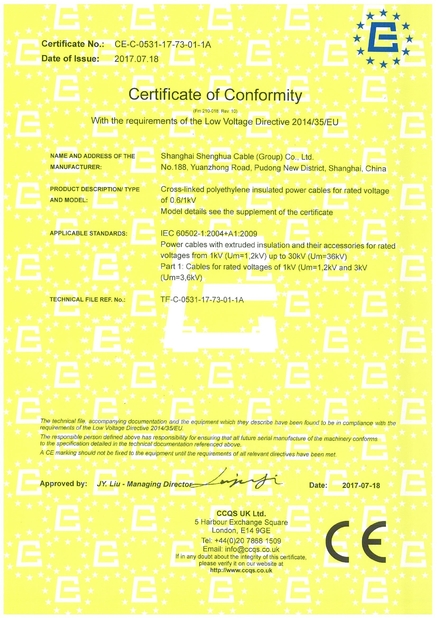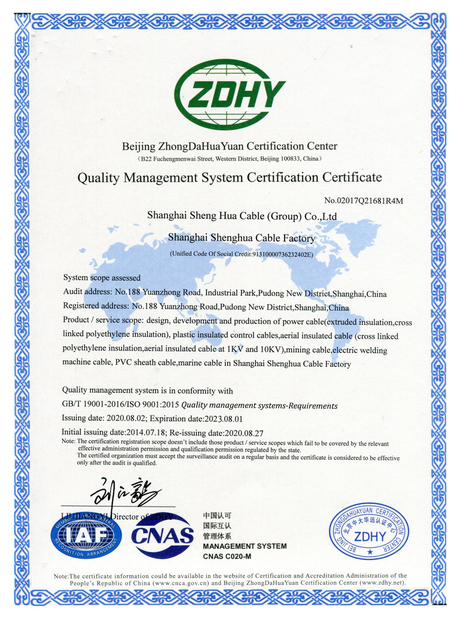
Cavo di Shanghai Shenghua (gruppo) Co., srl.
Every PVC insulated cable leaves the factory having passed a routine voltage test, and the number on the certificate, commonly 3.5 kV for a 0.6/1 kV cable, is one of the few values a buyer can verify without a laboratory. Yet the test is widely misunderstood: it proves insulation integrity at a moment in time, not service life, and it is only one of a series of routine tests that a complete certificate should show. This guide explains what the routine voltage test does, how the test voltage is chosen, what the other routine tests measure, and how to read a certificate to tell a properly tested cable from a well-presented one. Six answers follow on test duration, DC versus AC testing, failures and verification.

The routine test is applied to every length of finished cable, not to a sample. Its purpose is to detect gross insulation defects: a pinhole, a thin spot, a contamination, a damaged core, a fault at a joint during manufacture. A cable that survives the test has no defect large enough to break down at the test stress, which gives a high degree of confidence that it will not fail immediately in service.
For a 0.6/1 kV cable, the standard test voltage for the routine test is 3.5 kV alternating current applied between conductors and between conductors and the metallic screen or sheath, held for five minutes. The value is not arbitrary: it is chosen to stress the insulation well above operating voltage but below the level that would damage a sound insulation, and it is fixed by the standard so that results are comparable between factories.
The other routine tests are equally important, though less visible. Conductor resistance is measured on every length and must not exceed the standard maximum for that size and class. Insulation resistance is measured to confirm the insulation is not conductive or contaminated. Dimensions are checked, including insulation and sheath thickness and outer diameter, against the specified values. Together these tests establish that the cable is the product that was ordered, not merely that it does not short circuit.
| Routine test | What it proves | Typical result |
|---|---|---|
| Voltage test | No gross insulation defect | 3.5 kV AC, 5 minutes, no breakdown |
| Conductor resistance | Correct conductor size and material | Below standard maximum |
| Insulation resistance | Insulation quality | Above minimum for length |
| Dimensions | Correct construction | Within specified tolerance |
The first reason is that the test value reveals the voltage class. A cable offered as 0.6/1 kV but tested at 2 kV is not the same product as one tested at 3.5 kV, and the difference may indicate a 450/750 V construction being sold up. The test value is therefore a quick check on the class, and a supplier who cannot state it has not read the standard or does not want to discuss it.
The second reason is that the certificate structure reveals the testing regime. A serious certificate lists the tests performed, the standard reference, the measured values and the length tested, and it is traceable to a drum number. A certificate that shows only a voltage test and a stamp is a marketing document, not a quality record.
The third reason is that failures are informative. If a supplier reports that a batch needed repeated testing because of breakdowns, that is a process problem worth knowing about, even though the delivered cable passed. Buyers rarely receive this information, but a supplier who volunteers it is usually the one with a working quality system.
The fourth reason is that routine tests are not type tests. A type test demonstrates that a design meets the standard and is done once, often by a third party. A routine test demonstrates that a particular length is sound. Some enquiries confuse the two, and a supplier who sends a type test report while shipping untested cable is answering a different question. Both documents should exist, and they prove different things.
Finally, the test is a snapshot. A cable that passes the routine test can still fail in service if it is damaged during installation, if it is overloaded, or if the compound degrades. The test protects the buyer against manufacturing defects; it does not protect against installation errors or design mistakes. Products such as the VGV 3x1.5mm2 IP65 PVC Insulated Cable Marine Industrial 450/750V IEC60228 Copper and the 1-5 Cores XLPE Insulated Power Cable With Cable Size 1.5-630mm2 And PVC / LSZH Jacket ship with routine test data per drum, which is the practical level of assurance available at delivery.
Start with the standard reference. A certificate without a standard cited cannot be evaluated. Then check the voltage class and the test voltage against the standard for that class: 0.6/1 kV cable tested at 3.5 kV AC for five minutes is the expected entry for a PVC insulated power cable under IEC 60502-1.
Then look for the measured values rather than pass or fail statements. Conductor resistance in ohms per kilometre, insulation resistance in megohm kilometres, insulation and sheath thickness in millimetres, and the outer diameter should all be printed. Measured values allow comparison between batches and against the standard, and they show that the test was actually performed rather than stamped.
Check the traceability chain: drum number, length, production date, batch, and the signature of the person who released the goods. If the drum label does not match the certificate, the document is worthless. This is the most common failure of otherwise good paperwork, and it is trivially avoidable.
Ask for the type test report separately, and check its date, its testing laboratory and the range of sizes it covers. A type test on a single size does not cover the whole range, so confirm that the report you receive covers the sizes you ordered.
For large or critical orders, request a witnessed test. A third party attending the factory during the routine test converts a document into evidence, and the cost is usually small compared with the value of the order. Where that is not possible, retain a sample and, if a dispute arises, have an independent laboratory test it. The retained sample is more useful than any argument about a certificate.
Insulation resistance is measured to detect contamination, moisture and defects that do not cause a breakdown at the test voltage but reduce the margin. The result is expressed in megohm kilometres, which normalises for length so that a short length and a long length can be compared. A value well above the minimum suggests a clean, well processed compound; a value near the limit suggests moisture uptake, contamination or an overheated extrusion.
For the buyer, the useful habit is to record the measured value per drum and watch the trend over successive orders. A gradual decline across batches is an early warning of a compound or drying problem, and it appears long before a failure. The absolute number matters less than the direction of travel.
Routine tests cover every length; sample and type tests cover the design. A type test demonstrates that a construction meets the standard's performance requirements, including mechanical and thermal ageing, and it is performed once on representative samples. A buyer who receives a type test report for one size should check whether the report covers the sizes ordered, because the coverage is often limited.
Third party testing adds independence. A report from an accredited laboratory, or a witnessed routine test at the factory, converts a supplier's claim into evidence that can be shown to a client or an inspector. Where the order value justifies it, the cost is small, and it removes the argument that arises when a failure has to be attributed after the fact.
A breakdown during a routine test means the cable is not shipped, and the useful question is why. The cause may be a single defect, such as a damaged core during stranding, or a process problem, such as contaminated compound or an overheated extrusion. The distinction matters because a single defect is corrected and a process problem requires a change in production.
Buyers rarely see this information, but it is worth asking for when an order is critical. A factory that tracks failures and their causes can describe its rate and its corrective action; one that cannot is either very good or not measuring. The question costs nothing and the answer is informative in both directions.
Retesting after a repair is normal, but the record should show it. A certificate that quietly omits a failed first test is a documentation weakness, not necessarily a product weakness, yet it undermines confidence in everything else on the sheet. Transparency on a five minute test is a reasonable expectation for a long term supplier relationship.
Five items make a certificate useful: the standard reference, the test voltage and duration, the measured values, the drum number and length, and the signature with date. A certificate missing any of them is incomplete, and the missing item is usually the one that would allow verification.
Filing the certificates by drum number, alongside the retained sample reference, turns a shipment into a documented delivery that can be defended months later if a question arises about what was supplied.
3.5 kV alternating current for five minutes, applied between conductors and between conductors and the metallic screen or sheath, per the applicable standard.
No. The routine test is applied to every length; a type test demonstrates that a design meets the standard and is performed once on representative samples.
Yes, if it is damaged during installation or overloaded in service. The test covers manufacturing defects, not site handling.
It is the most direct check that the conductor has the ordered size and material, and it catches shortfalls that visual inspection misses.
For critical orders it is worth the cost. Otherwise, retain a sample and require measured values on the certificate.
Treat the document as void for that drum and ask for a replacement certificate with correct traceability.
The routine voltage test is a five minute check that separates sound cable from defective cable, and it is only one line of a certificate that should also carry conductor resistance, insulation resistance and dimensions, all traceable to a drum. Read the standard reference, the measured values and the traceability chain, and ask for the type test separately. Shanghai Shenghua Cable Group issues a routine test certificate for every drum, with the standard reference, the measured values and the drum number, and can arrange witnessed testing or third party inspection for critical orders. Send your technical requirements through our contact page and we will confirm the test regime for your specification. Related items include the Three Phase core copper conductor unarmored 600/1000V 3x10mm2 XLPE Insulated Power Cable, the Shenghua Power Cable Aerial Bundled Xlpe Insulation Cable , Aerial Power Cable With 1 Messenger Conductor, the VGV 3x6mm2 IP67 Waterproof PVC Insulated Cable Mining Industrial 0.6/1kV IEC60502, the VGV 3x2.5mm2 Rigid Oxygen-Free Copper PVC Insulated Sheathed Electrical Wire 1kV Industrial, the 0.6/1kV Aerial Bundled Cable for Power Distribution | ABC and the Medium Voltage XLPE Pvc Insulated Pvc Sheathed 3 Core Flexible Cable Sh Shenghua.
A test certificate is only as useful as its measured values. Filing them by drum, with a retained sample, converts a shipment into a record that can be checked years later.
Recording the measured values per drum is a five minute task at despatch that saves hours of dispute later.