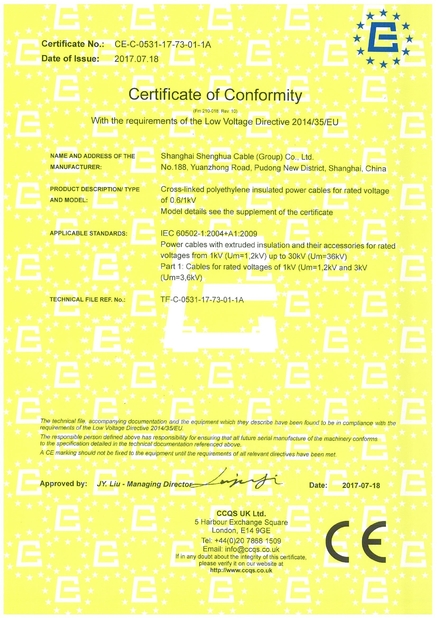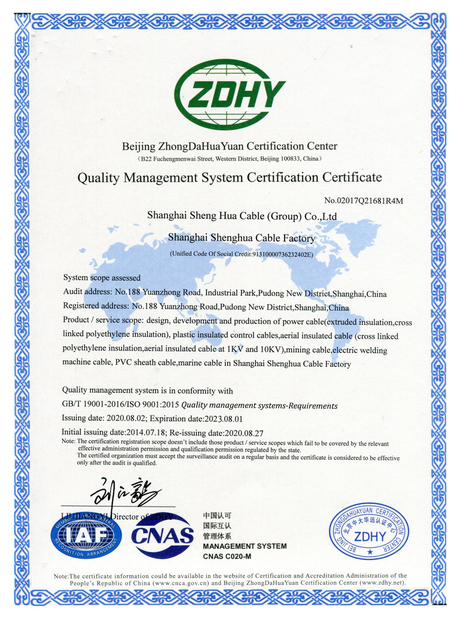
Cavo di Shanghai Shenghua (gruppo) Co., srl.
Mining cable is where ordinary cable specifications stop being sufficient. A trailing cable on a machine that moves, bends, drags and is occasionally run over is asked to do things that a fixed installation cable was never designed for, and a standard PVC insulated power cable substituted into that duty will fail early, sometimes dangerously. This guide explains what mining and heavy duty trailing cables must withstand, how the construction differs from a fixed cable, which standards and approvals matter, and how to specify a cable for a mine, quarry or tunnelling site. Six answers follow on flexibility, abrasion, earthing, approvals and replacement intervals.

The first demand is mechanical. Cables in a mine are dragged across rock, run over by vehicles, coiled and uncoiled, and pulled around corners. The sheath must resist abrasion and cutting, and the construction must tolerate repeated bending without the conductor strands work hardening and breaking. This is why mining cables use fine stranded conductors of class 5 or 6 rather than the class 2 conductor of a fixed power cable.
The second demand is earthing integrity. In a trailing cable, the protective conductor is part of a monitoring circuit that detects a broken earth before it becomes dangerous. Earth continuity monitoring depends on a reliable pilot or earth conductor, and the cable must be built so that this conductor is the last to fail. Some designs use a central pilot core, others a concentric layer, and the arrangement is part of the approval rather than an optional extra.
The third demand is fire and smoke performance. Underground, a cable fire is a catastrophic event, and most jurisdictions require flame retardant, low smoke and low halogen constructions. The relevant tests are more severe than the general building cable tests, and the certificate must cover the specific compound used.
The fourth demand is water and dust. Mines are wet, and the joints and terminations must survive. Cables intended for wet duty need water blocking or a construction that prevents water travelling along the conductor strands, and the terminations must be made with components rated for the environment.
The fifth demand is documentation. Mining regulators expect traceability: batch records, test certificates and, in many cases, approval numbers marked on the cable. A cable without the required marking cannot be installed on a regulated site, regardless of its physical quality.
| Property | Fixed installation cable | Mining / trailing cable |
|---|---|---|
| Conductor class | 1 or 2 | 5 or 6, fine stranded |
| Sheath | Standard PVC | Heavy duty, abrasion resistant |
| Earth arrangement | Separate or integral core | Pilot or monitored earth |
| Fire performance | Flame retardant | Flame retardant, low smoke |
| Marking | Standard print | Approval number, batch traceability |
The most common failure is using a fixed installation cable in a trailing role. The conductor is too stiff, the strands are too coarse, and after a few thousand flex cycles the strands begin to break near the termination where the bending is concentrated. The cable then overheats locally, and the failure appears as a burnt termination rather than a cable fault, which misleads the investigation.
The second failure is the earth path. A standard four core cable used without earth monitoring gives no warning when the protective conductor is damaged. In a regulated mine, that is not merely a maintenance issue but a compliance breach, and it is the reason mining approvals specify the earth construction in detail.
The third failure is sheath compound. A general purpose PVC sheath hardens in cold, softens in heat, and abrades quickly on rock. A heavy duty compound resists cutting and maintains flexibility over a wider temperature range. The difference shows up in months, not years, and replacement in a mine is expensive because it interrupts production.
The fourth failure is termination practice. Fine stranded conductors require suitable lugs and crimping, and a cable rated for flexible duty but terminated with a solid conductor lug will fail at the joint. The cable and the accessories form a system, and specifying one without the other is a common oversight.
The fifth failure is documentation. A site inspector will check the marking against the approved equipment list. A cable with the right performance and the wrong marking is unusable, and it is usually discovered after delivery, when it is most expensive to correct. Products such as the KVVP 4x1.5mm2 Shielded Flexible Oxygen-Free Copper PVC Insulated Control Cable 450/750V and the KVV 7x1.5mm2 Oxygen-Free Copper PVC Insulated Control Cable 450/750V Signal Transmission show how heavy duty constructions are described, and the differences from a standard power cable are visible in the conductor class and sheath specification.
State the duty first: trailing, reeling, or fixed. A trailing cable specification is different from a fixed one even where the voltage and current are the same, and the difference must appear in the purchase order, not only in conversation.
Then state the conductor class and the strand count. Fine stranded class 5 or 6 copper is the starting point for flexible duty, and the strand count should be high enough that individual strands are small relative to the bending radius the cable will see. Ask the factory for the strand construction rather than accepting class 5 as a word.
Specify the earth arrangement and the monitoring method. If the site uses earth continuity monitoring, the cable must provide the pilot or monitoring conductor the system expects, and the terminals must be identified. Confirm this against the site's equipment, because a mismatch is not fixable on site.
Specify the fire performance by standard and test, not by adjective. Flame retardant, low smoke and halogen free are claims; the standard reference and the test report are evidence. In a regulated market, the approval number is the real requirement, so ask which approvals the factory holds for the exact compound and construction.
Specify the mechanical protection: sheath compound, thickness, and whether additional reinforcement is needed for the specific route. For very severe duty, a reinforced or armoured variant may be appropriate, with the trade-off in weight and bending radius acknowledged.
Finally, plan the accessories and the replacement cycle. Trailing cables have a finite life measured in flex cycles, and a maintenance plan that inspects terminations and replaces cable at defined intervals costs less than emergency replacement during production. Products such as the 1.5mm² Multi-Core Control Cable for Industrial Automation, the Shanghai Shenghua Group Cable CU / Mica Tape Fire Resistant Cable For Sprinkler / Smoke Control System and the Armored XLPE Insulated Power Cable Aluminum Conductor Fire Resistant are representative of the heavy duty end of a cable range, and each can be quoted with the relevant test documentation.
Where the site is in a regulated jurisdiction, involve the site engineer in the specification early. The approval requirement is usually fixed by the regulator, and a cable that satisfies every technical requirement but not the approval is a dead end. Asking the question before the tender costs nothing.
A trailing cable has a finite life measured in flex cycles, and that life depends heavily on how the cable is supported and how the termination is made. A cable allowed to hang from a connector without strain relief concentrates bending at one point and fails there, while the same cable with a proper gland and a support loop lasts far longer. Maintenance practice, in other words, has as much effect on life as construction does.
Planning replacement on a defined interval, based on observed condition rather than on failure, avoids the cost of an unplanned stoppage. Inspection should look at the sheath for cuts and flattening, at the termination for discolouration, and at the earth conductor continuity. A cable that fails any of those checks is replaced before it becomes a hazard.
Temperature, water and chemical exposure vary enormously between sites, and a cable specified for one environment may be marginal in another. A wet mine with acidic water needs a sheath compound that resists both; a hot open pit needs a compound that does not soften in sun; a tunnelling project may need low smoke performance in a confined space. Each of those conditions changes the compound specification, not merely the marketing description.
The practical approach is to describe the environment in the enquiry in plain terms: wet or dry, ambient temperature range, presence of oil or chemicals, and whether the cable will be dragged over rock. A supplier who understands those conditions can propose a construction with the right compound, and the buyer avoids paying for performance that is not needed or discovering that the performance is insufficient.
Mines and quarries are often remote, and a cable that arrives late stops production. Lead time therefore becomes a specification item alongside the technical properties. A supplier who holds stock of the common sizes can deliver in days rather than weeks, and that availability is worth more than a small price difference when a machine is down.
The practical arrangement is a stock agreement for the two or three sizes that fail most often, held by the supplier or the distributor, with a defined call-off process. It costs a little to maintain and it converts an emergency into a routine delivery. For remote sites, holding one spare drum on site is also sensible, provided it is stored correctly and inspected periodically.
Packing matters for transport to a remote site. Drums must survive rough handling and long road journeys, and the cable must be protected from water and ultraviolet exposure during storage. A supplier who understands the destination will pack accordingly, and a buyer who states the destination and the storage conditions will receive a better shipment.
The specification for a mining or trailing cable can be reduced to five decisions: duty, conductor class, earth arrangement, sheath compound and approval. Get those five right and the rest follows. Get any one wrong and the cable will underperform regardless of the quality of the others.
Reviewing those five points at each replacement, rather than reordering the previous part number, also catches the cases where the duty has changed and the cable no longer matches the machine.
No. Fixed installation cable has a stiff conductor and sheath and will fail early under repeated flexing. Use a fine stranded trailing construction.
A monitored earth detects a broken protective conductor before it becomes dangerous. The cable must include the pilot or monitoring conductor the system expects.
Class 5 or class 6 fine stranded copper, to tolerate repeated bending without strand fatigue.
Flame retardant and low smoke requirements are defined by the applicable standard and regulator. Ask for the specific test report and approval number.
It depends on flex cycles, route severity and termination quality. Define an inspection and replacement interval rather than waiting for failure.
Yes. Lugs, glands and joints must be rated for fine stranded conductors and for the environment, or the joint becomes the weak point.
Mining and trailing cable duty demands fine stranded conductors, a heavy duty sheath, a monitored earth path, verified fire performance and correct marking, and a standard power cable cannot substitute for any of them. Specify the duty, the conductor class, the earth arrangement and the approval, and plan the accessories and the replacement interval. Shanghai Shenghua Cable Group supplies heavy duty PVC insulated cable with fine stranded conductors, abrasion resistant sheaths and monitored earth constructions, and it will confirm which approvals apply to the exact compound and size you need. Send your site conditions and duty cycle through our contact page and our engineers will propose a construction with the supporting test documentation. Related items include the Shanghai Shenghua Cable Copper Conductor PVC Insulated Multicore Control Cables , Steel Wire Armored Cable, the IP68 Waterproof Rubber Sheathed Cable H07RN-F 3x2.5mm2 Fountain Pump Submersible Cable 450/750V and the 2 core 240mm XLPE Insulated Power Cable Copper Conductor , Armored Electric Cable 0.6/1KV.