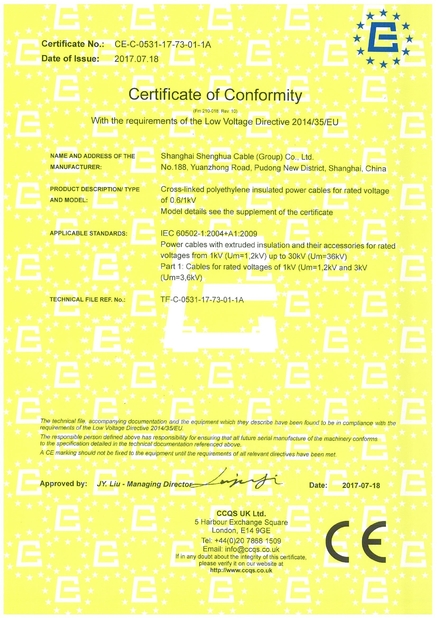
Cavo di Shanghai Shenghua (gruppo) Co., srl.
The service drop cable is where a distribution network meets a building, and it is the part of the network that fails most often because it is exposed, handled and frequently improvised. A correct service drop is sized for the load, tensioned for the span, insulated for the climate and terminated with connectors that survive ten years of thermal cycling. This guide explains the service drop cable options, from single core PVC insulated conductors in conduit to triplex and quadruplex aerial bundled service cable, how to size and install them, and how to make the transition from overhead to indoor wiring watertight and safe. It ends with six answers on span limits, clearances, earthing and inspection.

A service drop carries power from the last pole or the distribution main to the customer's point of supply. It is usually the lowest voltage and shortest span in the network, and it operates in the least controlled conditions: wind, sun, rain, tree movement, occasional contact and, in many networks, informal tapping. The cable must therefore combine electrical capacity with mechanical robustness and weather resistance, and it must be installable by a small crew with hand tools.
Four configurations cover most networks:
| Configuration | Typical voltage | Best use |
|---|---|---|
| Triplex ABC | 0.6/1 kV | Single phase overhead service |
| Quadruplex ABC | 0.6/1 kV | Three phase four wire service |
| Two core ABC | 600 V | Light service, street lighting |
| PVC single core in conduit | 450/750 V | Short facade drops |
Service drop work is where insulated overhead construction earns its reputation. A bare conductor service drop on insulators is vulnerable to tree contact, to birds and to informal tapping, and it looks unsafe to the customer even when it is compliant. An insulated bundled service drop solves all three problems at once, which is why utilities in Latin America, Africa and South Asia have largely converted.
A service drop failure is small in material terms and large in customer impact. It is the outage that a customer notices, and it is the one that generates complaints and, in regulated markets, penalties.
1. Undersized conductor for the load. Service drops are often sized historically, and loads have grown. A drop sized for a 5 kW house supplying an air conditioned property with an electric vehicle charger will run hot at the insulation limit, and the resulting failures appear at the connectors rather than in the middle of the span.
2. Poor termination practice. The most common defect is a taped twist joint at the pole or the building. It works when it is made and fails within a few seasons, because moisture enters the tape, the conductor oxidises and the joint becomes a hot spot. Insulation piercing connectors cost little and eliminate the failure mode.
3. Water entering at the building entry. The point where the drop enters the wall is where the cable is bent, clamped and often unsupported. Without a drip loop and a sealed entry, water tracks along the cable into the wall cavity and the meter box.
4. UV and insulation ageing. A service drop is fully exposed for its whole length. An unstabilised PVC insulation will chalk and crack within a few years, especially in tropical and desert climates, and the resulting earth fault may trip the whole street rather than the individual service.
5. Mechanical damage at supports. Hand-tied wire, sharp clamps and insufficient support spacing abrade the insulation at the point of suspension, which is where the mechanical load is highest and where water will collect.
Size from the load, not from the historical service. Add the expected future load, apply the diversity factor used by the utility and check the voltage drop over the actual span. For a 15 kW single phase service at 230 V, the design current is about 65 A before diversity, which suggests a 25 mm2 conductor or a 35 mm2 for longer spans, subject to the utility standard. Voltage drop, not thermal capacity, frequently governs the size on long rural drops.
Size the messenger for the span. Spans up to 30 m are common in urban service connections, with longer spans in rural areas. Above 40 m the messenger and the pole class should be recalculated, and the sag must not allow the conductor to approach the ground or a roof under wind and thermal expansion. Use a tension gauge and a sag template rather than judgement, and support the cable at intervals defined by the utility standard, typically 0.5 to 1 m on a facade.
Terminate with proper connectors. At the pole, use an insulation piercing connector rated for aluminium or copper as appropriate, and torque it. At the building, use a sealed entry with a drip loop and a secure clamp so that the cable weight is not carried by the terminal. Where the drop meets an indoor cable, make the transition in a sealed enclosure, not in the wall cavity, so that it can be inspected and maintained.
Earth correctly. The neutral or messenger is earthed at the defined point, and the installation earth is bonded in accordance with the network earthing arrangement. Where the service is part of a TN-C arrangement, the transition to the customer's TN-S system must happen at a specified point and the combined conductor must not continue into the installation.
Finally, commission with tests. Insulation resistance of each phase to neutral and to earth, continuity of the neutral and messenger, and a visual check of clearances, sag and support integrity. Photograph the completed drop: service connections are modified informally over the years, and a photograph at commissioning is the only reliable record of how the installation started.
| Element | Typical requirement | Common defect |
|---|---|---|
| Conductor size | Load plus future load, voltage drop checked | Historical size retained |
| Messenger | Sized for span, wind and ice | Undersized for long span |
| Supports | Per utility standard, elastomer inserts | Hand-tied wire, sharp clamps |
| Connectors | Insulation piercing, torqued | Taped twist joint |
| Building entry | Sealed, drip loop, clamped | Water path into wall |
| Earthing | Per network arrangement | Neutral used as earth indoors |
Typical products include the XLPE and PVC insulated aerial bundled triplex service drop cable, the 0.6/1 kV triplex and quadruplex service ABC with flame retardant insulation, and the three core aerial bundled triplex service drop cable for overhead lines. Light service connections can use the 600 V two core aerial bundled cable 2.5-70 mm, while three phase services use the 0.6/1 kV triplex and quadruplex ABC for power distribution or the aerial bundled cable with one messenger conductor. Where the drop runs along a facade in strong sun, the UV resistant PVC insulated 4x35mm2 cable is appropriate, and the upstream bare conductor is covered by AAC overhead bare conductor.
In many networks the service drop is not only a technical element but a social one. Illegal connections made by hooking a bare conductor at a pole are the classic cause of both technical losses and safety incidents, and they are extremely difficult to remove once established. An insulated bundled service drop with sealed insulation piercing connectors removes the easiest access point, and combined with a sealed meter box it makes unauthorised connection visibly obvious. Utilities that have run conversion programmes consistently report both lower losses and fewer complaints, because the network stops looking improvised and starts being maintained as designed.
Most service connection work is carried out live or near live, which imposes practical requirements on the cable and the accessories. The cable must be robust enough to be handled with insulated tools and to resist abrasion when pulled over a bracket, and the connectors must be installable from a ladder with a limited tool set. Insulation piercing connectors with a torque-limiting head are the practical answer, because they remove the need to strip insulation in the air and they control the contact pressure that would otherwise be guesswork. A service cable that is easy to install properly is a service cable that gets installed properly, and that is a safety feature as much as a convenience.
Utilities converting from bare conductor to insulated service drops benefit from standardising the construction early. A small number of approved configurations, one for single phase services, one for three phase and one for street lighting, with a fixed connector type and a defined support spacing, reduces training time and stock complexity and makes inspection possible. Standardisation also simplifies procurement, because the utility can order in volume and specify the same messenger and insulation for every service, rather than accepting whatever the contractor supplies. In practice, the cost saving from standardisation usually exceeds the difference in cable price between the two options being debated.
One final point on stockholding. Service drops are replaced at short notice, often after a storm, so utilities that keep a standard service cable on the shelf restore supply in hours rather than days. That argues for a simple range: one triplex and one quadruplex size covering most connections, with a defined connector to match. The alternative, a bespoke cable for every connection, looks economical on paper and expensive in the depot, because the one drum a crew needs is always the one that has run out.
Documentation closes the loop again. A service connection record that shows the cable type, the conductor size, the span, the connector used and the test readings gives the utility a maintenance history per customer, which is what allows a targeted replacement programme instead of a reactive one. It also proves due diligence if an incident is investigated, and it takes less than a minute to complete at commissioning.
Urban service spans are commonly 20-30 m. Above 40 m the messenger, the pole class and the sag must be recalculated, and some utilities set a maximum of 50-60 m.
Clearances are set by national codes and vary with voltage and traffic. They must be verified on site, not assumed from the drawing.
No. Taped twist joints absorb moisture and become hot spots within a few seasons. Use insulation piercing connectors or compression connectors with proper sealing.
It follows the network earthing arrangement. Where the network uses a combined neutral and earth, the split to the customer installation must occur at a defined point with proper bonding.
Use a sealed entry gland, form a drip loop below the penetration and clamp the cable so that its weight does not load the terminal.
Only with a UV stabilised compound and adequate mechanical support. In strong sun and long spans, XLPE insulation with a UV stabilised sheath is the more durable choice.
A service drop is a small cable with a large reputation, because it is the part of the network the customer sees and the part that fails first when it is improvised. Size for the load and the voltage drop, support the cable properly, terminate with real connectors, and make the building entry watertight. Those four decisions remove most service callbacks. Shanghai Shenghua Cable Group manufactures triplex and quadruplex ABC, two and three core service cable and UV resistant single core PVC cable for overhead connections, with messenger options and utility standard compliance. Send your load, span and utility requirements through our contact page and our engineers will propose the construction and the accessory list for your service connections.